
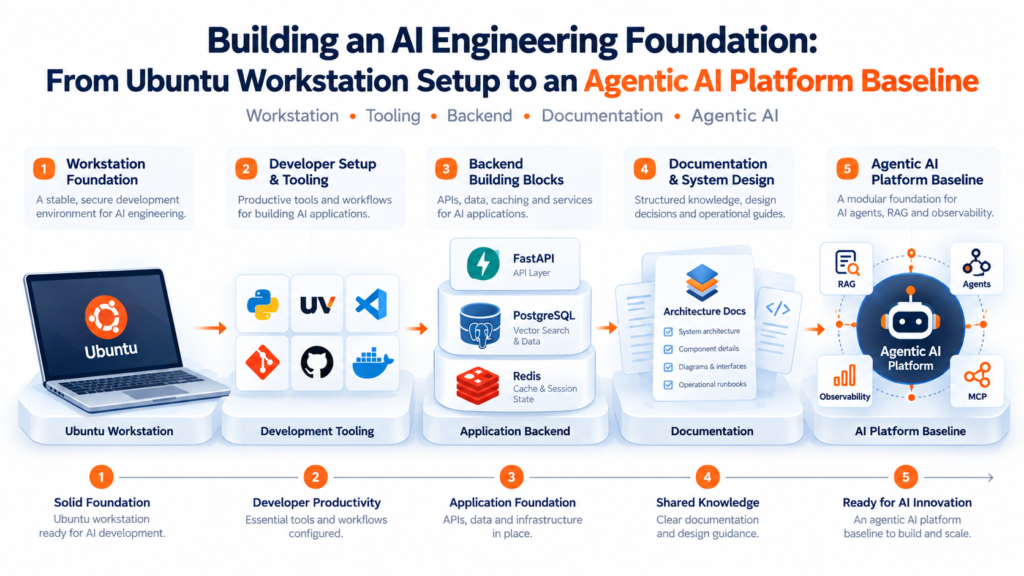
building-ai-enginbuilding-ai-engineering-foundation-ubuntu-agentic-ai-platformeering-foundation-ubuntu-agentic-ai-platform
In modern AI engineering, many teams focus directly on models, agents, and orchestration workflows—but often overlook the importance of building a strong technical foundation first.
Before scalable AI systems can become reliable, maintainable, and production-ready, they need a solid platform underneath them: a clean development environment, a well-organized workspace, dependable infrastructure services, and disciplined engineering practices.
Recently, I worked through the process of setting up a practical AI engineering foundation on Ubuntu Linux. The goal was not simply to “run code,” but to prepare an environment capable of supporting future work in backend APIs, retrieval systems, agent runtimes, orchestration patterns, and enterprise-grade AI services.
This article summarizes that journey and the engineering principles behind it.
1. Why the Foundation Matters
When building agentic AI systems, the real challenge is rarely just the model itself. The challenge is creating an environment where different layers can work together effectively:
- development tooling
- reproducible Python environments
- containerized infrastructure
- databases and caching layers
- backend APIs
- testability and validation
- architecture documentation
- future extensibility for agents, RAG, orchestration, and observability
A strong foundation reduces friction later. It helps teams avoid messy environments, inconsistent dependencies, fragile infrastructure, and undocumented architecture decisions.
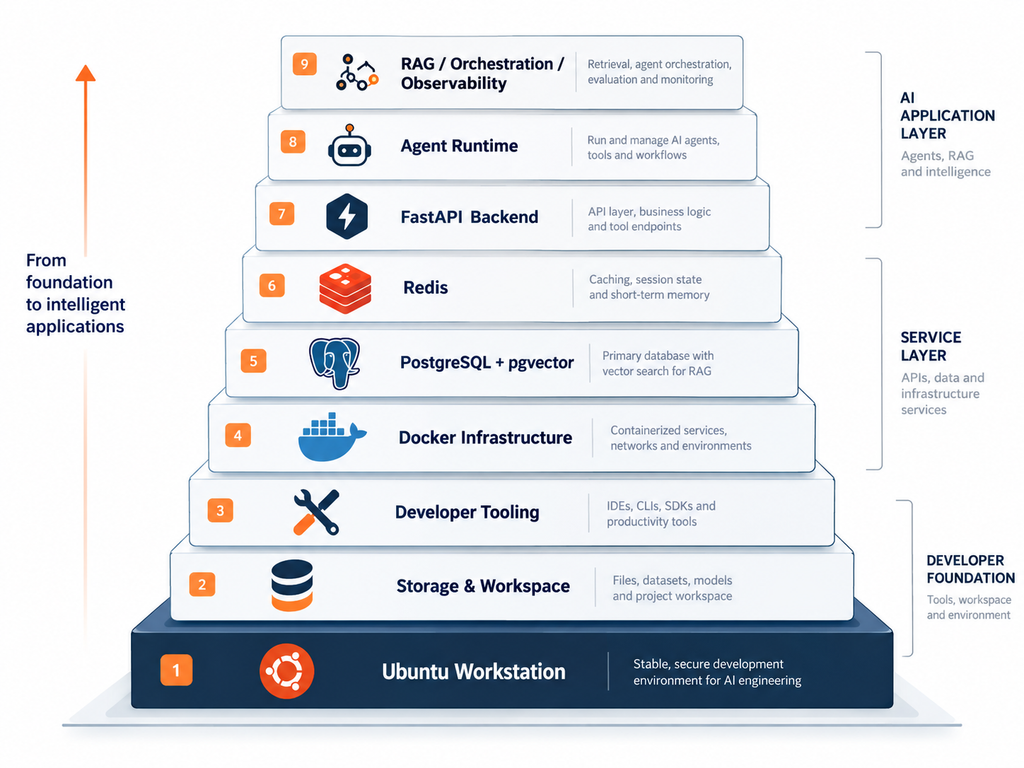
High-level view of the AI engineering foundation stack.
2. Preparing the Ubuntu AI Workstation
The first step was preparing the operating environment itself. This included validating the machine’s CPU, memory, storage, and GPU readiness, then organizing the workspace in a way that separates the operating system from project data.
A dedicated Linux workspace partition was especially useful because it creates a cleaner boundary between the system environment and development assets. Instead of scattering projects, caches, and container data across the default filesystem, the workspace becomes the central location for AI projects and infrastructure resources.
This approach improves maintainability and makes it easier to reason about storage usage over time—especially when working with containers, virtual environments, datasets, and future model artifacts.
Equally important was verifying NVIDIA driver availability and GPU visibility. For AI development, even if GPU-heavy model workloads are not yet running, validating the graphics and compute stack early prevents future surprises.
3. Establishing the Developer Toolchain
Once the workstation was ready, the next layer was the developer toolchain.
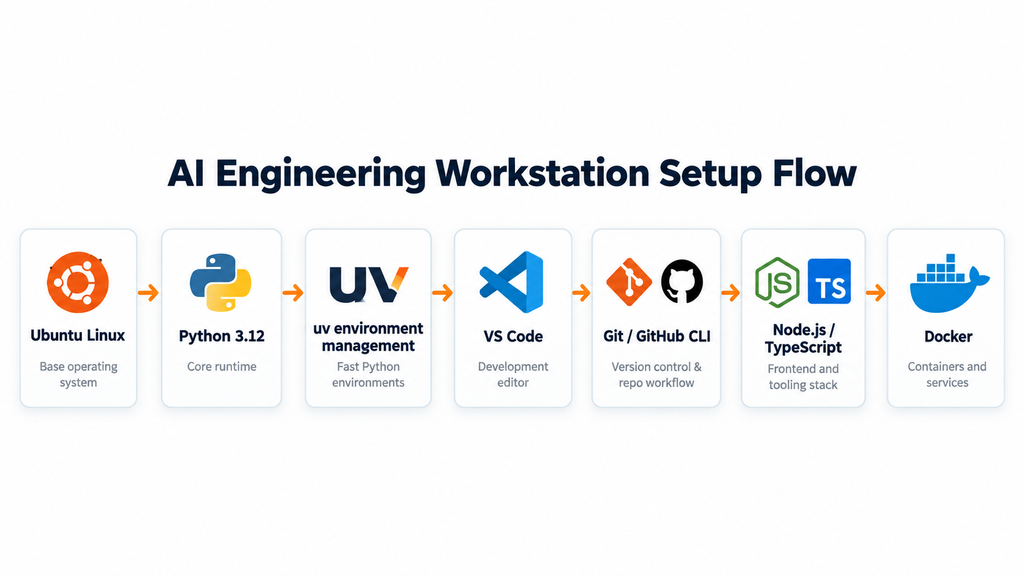
A clean engineering setup benefits from a predictable development stack. In this case, that included:
- Git for version control
- Python 3.12 for project runtime compatibility
uvfor fast Python environment and dependency management- Visual Studio Code for development
- GitHub CLI for repository workflows
- Node.js and TypeScript tooling for future frontend or supporting services
- Docker and Docker Compose for infrastructure management
One of the key lessons here is that developer productivity is heavily influenced by setup quality. A good workstation should make common tasks simple:
- creating isolated environments
- installing dependencies
- opening projects quickly
- managing repositories
- testing changes consistently
- running local infrastructure without manual complexity
Good tooling reduces cognitive load and allows more focus on architecture and implementation.
4. Containerized Infrastructure as the First Real Platform Layer
After preparing the machine and toolchain, the next meaningful milestone was bringing up the platform’s core infrastructure services.
Rather than installing services directly on the host, the better engineering choice was to run them through Docker. This keeps the environment cleaner, more reproducible, and easier to maintain.
The initial service baseline included:
- PostgreSQL as the primary relational database
- pgvector for vector extension support
- Redis for caching and fast in-memory service needs
This is a practical combination for modern AI platforms. PostgreSQL provides structured storage and reliability. pgvector prepares the system for similarity search and retrieval use cases. Redis supports fast operational patterns commonly needed in APIs, agent workflows, queues, and session-like scenarios.
Another important improvement was relocating Docker storage to the dedicated workspace. This keeps container data, volumes, and runtime artifacts away from the main OS partition and makes resource usage easier to manage.
From an engineering standpoint, this step marks the shift from “a developer laptop” to “a local platform environment.”
5. Building the Backend Baseline
With infrastructure services running, the next layer was creating a backend baseline.
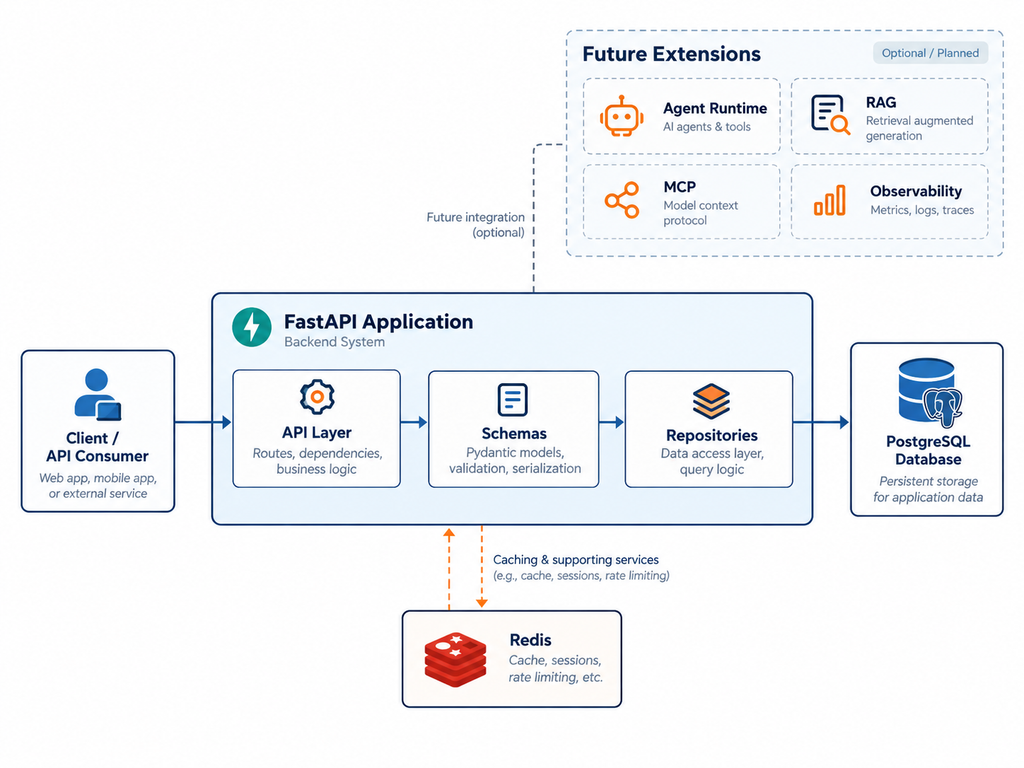
The backend was intentionally kept simple and disciplined:
- FastAPI application structure
- environment-based configuration
- async database connectivity
- SQLAlchemy foundation
- Alembic migrations
- API routing
- health checks
- an initial domain model
- repository pattern
- schema validation
Even a very early backend benefits from being organized correctly. A clean backend structure makes future development significantly easier when new modules are introduced for:
- agent definitions
- model gateways
- retrieval pipelines
- orchestration services
- MCP integrations
- security layers
- observability components
This is where architecture matters. It is far better to establish a maintainable structure early than to refactor a chaotic codebase later.
6. Testing, Validation, and Engineering Confidence
One of the most valuable parts of the process was not just building components—but verifying them.
A foundation is only useful if it can be trusted. That trust comes from validation:
- service connectivity checks
- database migration checks
- API endpoint verification
- test database isolation
- repository behavior validation
- health endpoint testing
- pagination and error handling validation
- code coverage reporting
This kind of testing may feel “early” to some teams, but in reality it is never too early. The earlier testing enters a project, the easier it becomes to evolve the system confidently.
By validating the platform baseline through automated tests and coverage measurement, the system moves beyond being a rough prototype. It starts becoming an engineered product.
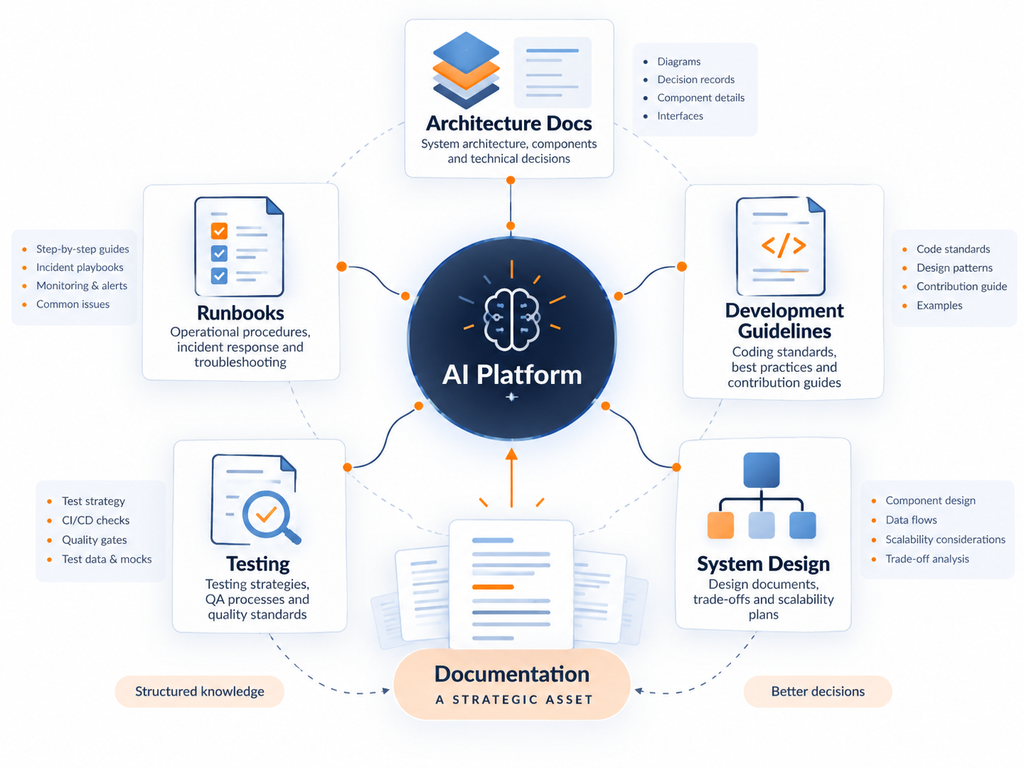
7. Documentation Is Part of the Architecture
Another major lesson from this work is that documentation should not be treated as an afterthought.
Good engineering documentation serves several purposes:
- it captures design intent
- it explains structure and responsibilities
- it reduces onboarding friction
- it preserves architectural decisions
- it improves consistency
- it supports future scaling
Architecture overviews, project structure guides, runbooks, and development guidelines are not “extra” work—they are part of the product’s engineering quality.
Especially in AI platforms, where systems quickly become multi-layered, documentation becomes a strategic asset.
. Key Takeaways
This experience reinforced a principle I strongly believe in:
AI systems should be engineered, not improvised.
Before advanced multi-agent orchestration, RAG pipelines, or production-grade intelligence layers, teams need:
- a clean workstation setup
- organized storage and workspace management
- reproducible tooling
- containerized infrastructure
- reliable backend foundations
- testing discipline
- architectural clarity
- documentation maturity
These foundational steps may not look flashy, but they are exactly what make more advanced AI systems sustainable.
As the AI ecosystem moves toward increasingly complex agentic systems, the teams that succeed will be those that treat AI development like real engineering—not just experimentation.
Final Thoughts
Building the foundation is rarely the most public part of AI work, but it is often the most important.
A well-prepared workstation, a clean backend baseline, solid infrastructure, and strong engineering discipline create the conditions for future success. Whether the next step is multi-agent orchestration, retrieval-augmented generation, model routing, or enterprise AI automation, the value of a strong foundation compounds over time.
In future articles, I plan to share more insights on agentic AI architecture, engineering patterns, and practical implementation approaches for scalable intelligent systems.